
News
NZHPA Safety taskforce summary - #1 GROUND HANDLING
Friday, 8 September 2023
A SUMMARY OF FINDINGS FROM THE 
NZHPA FREE-FLYING SAFETY TASKFORCE


The NZHPA (New Zealand’s version of SAFA) commissioned a safety taskforce to look into the safety of free flying in NZ. Their findings can be directly applied to our own flying here and make for interesting (if sometimes unsurprising) reading.
The THPA Safety Committee have distilled the information down from the full 65-page document to make it more digestible. As the taskforce did in their own methodology, we will break it down into different aspects of flying.
Selected notable findings outlined in the report include:
• Structured intermediate progression is limited, inconsistent, or absent. This creates a void that bad habits and risk taking can fill. 
• Local weather conditions are implicated in many incidents with pilots reporting not being aware or not fully understanding how conditions affect their intended flying. 
• Human factors such as situation awareness, judgement, and decision making are implicated in many accidents with pilots reporting, in hindsight, the mistakes they made. 
• Building a just culture and greater willingness to share our mistakes is imperative for the learning needed to understand and progress safety. 
• Modern free flying equipment is generally sound and rarely leads to safety incidents through direct failure. Judgement around use, level of equipment, unfamiliarity, and poor set-up (all human factors) is a different story.
Following below are more detailed findings on different phases of flying, skill attainment and maintenance, weather, human factors, incident reporting and equipment.

1. GROUND HANDLING
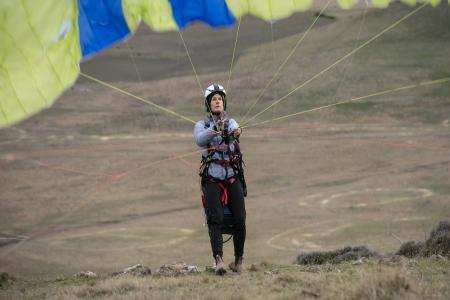
In an analysis of 28 recent launch-related incidents, at least 80% of cases showed poor ground handling as a contributor and/or more ground handling practice may have helped prevent the incident.
1. Ground handling the wing is an inherent requirement for launching. Launching is where the second highest number of reported accidents and incidents occur and is where injuries are recorded as being most severe. Many AIRS reports included reported or apparent ground handling issues on launch, either on their own or in combination with other issues (normally a misunderstanding of wind/conditions).

2. Ground handling is observable, more easily corrected, and safer to practice. 

3. Ground handling is a very strong proxy for handling the wing in all other phases of flight. 

4. Ground handling gives the opportunity to train out the desire to look at the glider (looking at the glider denies the pilot crucial pitch and roll attitude and ground proximity information). 

5. Information from the graduate pilot survey suggested that despite its importance as outlined in 1-4 above, ground handling tends not to receive as much attention as ‘flying’ when it comes to formal training and self-practice. 

6. Given all the above, ground handling is potentially a big quick win for tackling ground-handling-on-launch incidents and understanding and practising wing handling in other phases of flight.
Recommendations 

â— Recognise that due to practical and commercial constraints that the PG2 and equivalent syllabi are only a starting point for learning.

◠Engage in more regular ground handling practice and deliberate flying skills consolidation.

◠Ask for guidance from more experienced pilots to avoid reinforcing bad techniques or habits. 

◠Form a group to make ground handling a social event as well.

◠Seek further professional training to maintain and progress both skillset and the types of flying that should be conducted. Seek out schools and or individuals who offer advanced progression training that includes ground handling. 

â— Alternatively, acknowledge that you might remain at a ‘beginner’ or ‘new intermediate’ level for longer and fly accordingly. Taking this route, however, does not absolve pilots from currency and skill maintenance considerations.
More to follow... stay tuned.